Bunions
Dr. Ramos is board certified by the American College of Foot and Ankle Surgeons. In addition, he holds board certification in Minimally Invasive Foot and Ankle Surgery. Therefore, you can feel confident that you are receiving care from one of New Jersey's most qualified foot and ankle specialists.
A bunion is an enlargement of the base joint of the big toe where it connects to the foot. This enlargement forms from either swollen tissue or a bony growth. It develops when the bones in the big toe shift inward toward the other toes. As a result, the area around the base of the big toe becomes inflamed, red, and painful.
Genetics play an important role in bunion development. For example, many people who develop bunions are genetically predisposed to this type of bone displacement. However, certain habits can trigger or worsen the condition. Wearing poorly fitting shoes and walking or running in ways that put stress on the feet can both speed up bunion formation.
Furthermore, wearing high heeled shoes is another common cause. High heels push the toes into an unnatural position, which forces the bones out of alignment over time. Therefore, choosing supportive and properly fitting footwear is one of the best ways to protect your feet.
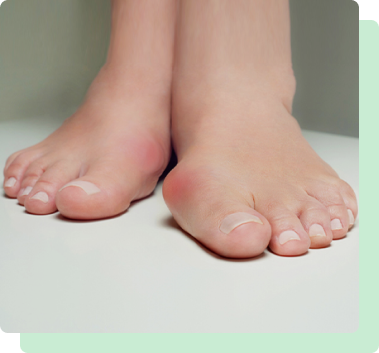
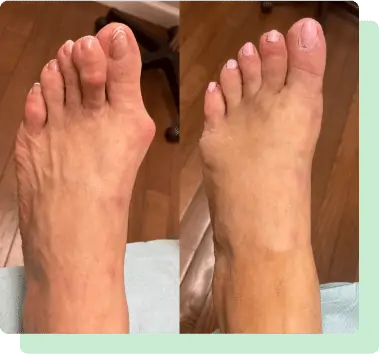
Dr. Ramos can quickly diagnose a bunion during your visit. First, he will examine the structure and mechanics of your foot. He may also order blood tests to rule out gout or arthritis, since these conditions can look similar to a bunion. In addition, he may take an X-ray to get a clear image of the bone structure. If the X-ray shows an enlarged joint near the base of the big toe shifting toward the smaller toes, this confirms a bunion diagnosis.
Treatment for bunions starts with simple conservative steps. For example, switching to wider shoes removes pressure from the bunion and reduces pain. In addition, avoiding high heeled shoes for a period of time can help, since they push the big toe outward toward the smaller toes. For many patients, these changes alone are enough to eliminate discomfort. However, if pain continues, Dr. Ramos may recommend anti-inflammatory medications. Furthermore, severe pain may require a steroid injection near the bunion. Custom orthotics are another effective option, as they redistribute pressure across the foot and provide significant relief. However, it is important to understand that orthotics reduce pain but do not correct the underlying bone problem.
For cases that do not respond to conservative treatment, Dr. Ramos performs minimally invasive surgery to reposition the toe. During the procedure, he removes a small section of bone or rearranges the ligaments and tendons to keep the toe properly aligned. As a result, you can enjoy lasting relief and restored function in your foot.